

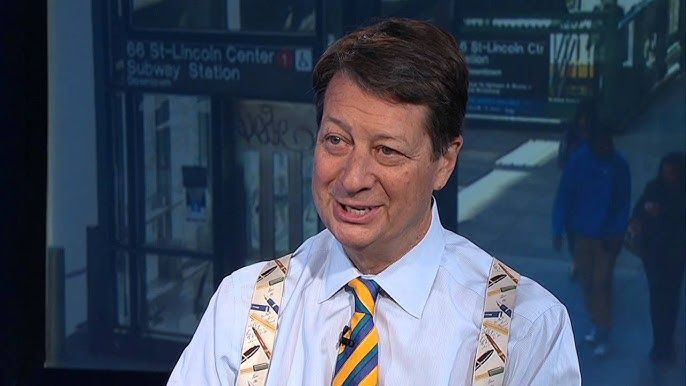
Neal Shapiro
Neal Shapiro: Like the Boxer, Public Media is Staggared but Still Standing
Like the bruised boxer in the iconic song, Neal Shapiro says public media has suffered body blows at the hands of the Trump administration but is still standing.
The outgoing CEO of the WNET Group did not eulogize public media; he diagnosed its challenges. Shapiro laid out what the Trump administration’s elimination of $500 million in annual federal funding has actually meant in conversation with former Silurians president Betsy Ashton at the Siluirans Press Club's Feb. 18 luncheon.
"We are like a boxer, I’d say,” he said. "We’re staggering. We’re not down for the count, but there has been damage.” For a room full of veteran journalists, many old enough to know Paul Simon’s “The Boxer” by heart, the metaphor needed no translation. They appreciated exactly where public media stood in the song.
The cuts—$350 million for public television, $150 million for public radio—hit WNET alone for $12 million to $14 million. “American Masters and American Experience are on hiatus and may never come back,” he said. The room absorbed this punch with an audible murmur. Staffing has fallen sharply: “When I started, we had 420. We’re going to have like 280, maybe less.” Because major projects take years to produce, he warned, viewers have only begun to feel the fallout.
The justification, he argued, was largely contrived. At $1.85 per taxpayer,Shapiro said public media was no budget buster. Attacking it simply “plays very well with the base.” His pushback was almost defiant. “We’ve done a trust survey 31 years in a row (and) we are the most trusted institution in America.” As for bias claims against the NewsHour, Shapiro said, “I’ve sat in their morning editorial meetings—they don’t say, here’s our agenda...The question is, what can we add to the story? What different points of view can (we) get?” The audience, he said, splits into equal thirds—Republicans, Democrats, Independents. “Kind of like the electorate.”
Where Shapiro’s tone shifted from bruised to animated was on digital platforms.
“The biggest single platform where people are watching content is YouTube,” he said to more than a few raised eyebrows, the kind that belong to a generation who remember when “platform”meant some kind of stage. The same Nature documentary that skews 60% 55-and-older on Channel 13 draws a far younger, broader crowd on YouTube.
The catch: “We don’t get that data.” YouTube owns it.
Public media may land the punches yet someone else is keeping score. With television, stations know their viewers and can cultivate them. Online, public media may get the eyeballs but not the email addresses and no direct line to support or fundraising. Still, Shapiro said abandoning those platforms would be the greater mistake.
Younger viewers don’t watch “the way the producers intended.” They choose what, when, where, on which device, and often in what order. Frontline on YouTube gets broken into six segments. Viewers skip around freely. “It’s ironic,” he said, “because we put so much agony into how we’re going to roll these things out.”
The traditional membership model doesn't work for them, either. “Our generation joins things,” Shapiro said, drawing knowing snickers from the crowd. The next generation is “much more transactional, much more driven on use.” Corporate underwriting has largely vanished, too. Civic-minded sponsorships replaced by commercial calculation.
One proposed workaround was modest in scale yet staggering in ambition: “If 100 million people gave us a dollar, that would be real money.”
Simon wrote that “a man hears what he wants to hear and disregards the rest.” The Trump administration is counting on exactly that. Public media's real test will be whether the crowd in the rafters, watching on YouTube, gives a dollar to help even out the match.