


Chuck Scarborough

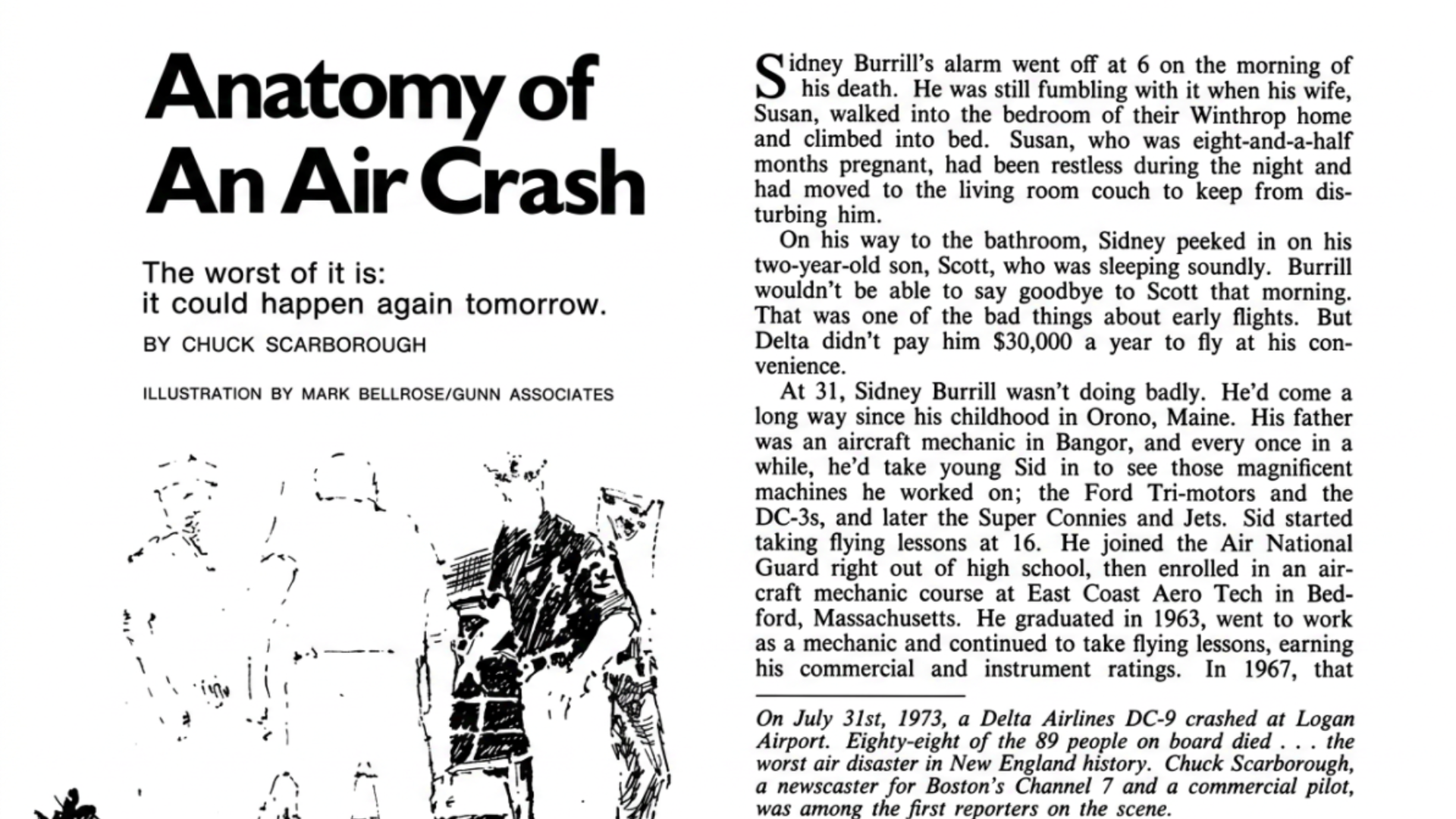
Anatomy of an Air Crash
In 1973, Scarborough covered the crash of Delta Air Lines Flight 723 at Boston's Logan Airport. Holder of a commercial pilot's license, Scarborough kept digging for details. Realizing he had too much material for TV, he wrote this article for Boston Magazine.
Chuck Scarborough, 2026 Lifetime Achievement Award
By Mel Laytner
Before stepping up to accept the Silurians Press Club’s Lifetime Achievement Award, Chuck Scarborough had done a quick investigative search on his hosts.
He learned from Google that Silurians are “an intelligent reptilian species” that “often have three eyes” and that they “frequently clash with humanity over the ownership of the planet.” Turning to his interlocutor, legendary radio reporter Rich Lamb, Scarborough said a “Rich Lamb” was “a bold, deeply flavorful ragu perfect for serving over pasta.”
“So, you can imagine my disappointment,” Scarborough deadpanned, setting a breezy, self-deprecating tone for the Silurians’ May 20 luncheon at the National Arts Club.
In presenting the award, incoming Silurians president Fran Carpentier noted that Scarborough, 82, had served as lead anchor at WNBC for "an extraordinary 50 years, 8 months and 17 days, a record unmatched in New York broadcast history." Along the way, he earned 36 Emmy Awards, an Edward R. Murrow Award, and a DuPont-Columbia Award.
Yet what emerged was not the polished anchorman image that generations of viewers knew nightly from 30 Rock. Instead, Scarborough spoke mostly as a reporter—the shoe-leather genus of that species—covering disasters on foggy runways and in crowded hospitals, and working sources to nail down exclusives. That played well with a room full of veteran reporters and editors focused more on how stories are chased than how they are read from a teleprompter.
As a young anchor in Boston, he vividly recounted covering the 1973 crash of Delta Flight 723 at Logan Airport, where thick fog and pilot confusion sent a jetliner into a seawall. Arriving at the airport firehouse, he recalled: “I turned around and there were 30 bodies that had just been extracted with the wreckage lined up on the floor of the airport fire station.” A pause. “They'd been alive an hour earlier.”
“I became so obsessed with why that crash occurred. I have a commercial pilot's license. I couldn't imagine how a plane could make that kind of a mistake,” Scarborough said. “So I began this digging.”
He gathered “all the NTSB stuff” — cockpit and tower recordings, flight data and radar track. Scarborough interviewed families of some of the 89 victims and of the three pilots aboard, “and I reconstructed the whole flight minute by minute.
”
“I had so much information that I realized it was way too much data, way too much material for television. That wasn't the right medium for this.” Instead, Scarborough wrote Anatomy of a Plane Crash for Boston Magazine.
“Print has a specific advantage over broadcast, and that is when you need lots of detail,” Scarborough said. “You can dig in.”
His pilot’s chops also came into play reporting on the 1977 Tenerife disaster, the runway collision of a KLM and a Pan Am jumbo jet that killed more than 560 people. Well before authorities released them, Scarborough had obtained cockpit voice recorder transcripts from a source via a brush pass of the documents “under the statue of Atlas on Fifth Avenue."
The transcripts clearly put blame on the KLM pilot. “But before I went on the air with that, I wanted to try to get a second source, as we always do.” He called a friend at NTSB. The official said he couldn't comment. Pressed, he then told Scarborough you’re "on your own." NBC broke the story that night.
Then there was Marla Hansen, the model slashed by her landlord in 1986. With every TV crew in New York camped outside St. Vincent's Hospital, Scarborough recalled, “I just walked into the hospital like I belonged there.”
He approached the second-floor nurse's station. “I said, ‘I'm here to see Marla Hansen. What room is she in?’ And the nurse directed me. [I] walked into the room, and here was this diminutive young woman alone with stitches all over her face in this hospital bed.”
Hansen had seen Scarborough on the 6 o’clock news. She was furious that he had suggested her modeling career was over. “I said, well, listen, I think maybe we should say something about that on the 11 o'clock news tonight to correct that. Would you like to say something on camera? And she said, absolutely.”
Scarborough orchestrated a race against the clock to secure medical permissions, roll tape at 10:20 p.m., rush back to 30 Rock by 10:55 p.m., and dive into the anchor chair to broadcast a major scoop.
Not all of Scarborough’s stories were this fraught. With Lamb egging him on, Scarborough recalled the yarn involving WNBC's brilliant, asthma-suffering news director, Jerry Nachman. While Nachman was recovering in the hospital from a life-threatening attack, assignment editor Mike Callahan invited Scarborough to join staffers for a visit to Nachman's room.
There was Nachman, propped up on pillows, wheezing about how an accidental steroid overdose almost killed him that morning. A woman in a sharp professional suit carrying a clipboard walked into the room, claiming to be conducting a hospital survey. When Nachman loudly complained about his treatment, she set down her clipboard, pulled a tape recorder out of her purse, pressed play on a bump-and-grind track, and began to disrobe.
“Callahan had hired a stripper,” Scarborough roared. As the stripper danced around the bed down to her pasties and G-string, Nachman's phone rang. Nachman picked up the receiver, panting for breath. It was Nachman’s wife.
“No, sweetheart, I'm not smoking.”
“But we can't do this kind of stuff anymore,” Scarborough said over the crescendo of laughter. “This is not permissible, but back then it was just good fun.”
---
Mel Laytner, a Silurians Board member, was a reporter and editor of hard news for 20 years, much of it covering the Middle East for NBC News and UPI. He is author of the acclaimed investigative memoir, What They Didn't Burn.