Marvin Kitman

Iconoclastic Reviewer of Our Most Popular Medium

Marvin Kitman once claimed he never watched television until someone paid him to do it.

“I may be crazy,” he said, “but I’m not stupid.”

Nonetheless, Kitman devoted much of his life — including more than 35 years as the television critic at Newsday — in front of a TV. His views of the medium weren’t exactly what television executives wanted to read, but that mattered little to Kitman, whose iconoclastic, irreverent and witty verdicts made his syndicated column one of Newsday’s most popular features.

A long-time Silurian who made several appearances as a luncheon speaker over the years, Kitman died of cancer on June 29 at the Actors Fund Home in Englewood, N.J., not far from his home in Leonia. He was 93.

Kitman’s critiques had nothing to do with the size of a particular program’s viewing audience. He was generous with praise for such innovative programs as “All in the Family,” “Seinfeld,” “M*A*S*H” and “Monty Python’s Flying Circus,” and he skewered numerous shows that drew major audiences — “Laverne & Shirley,” “Three’s Company” “Dallas” and “Charlie’s Angels,” for example — labeling them “pap.”

As befits a critic, he exuded self-confidence. While enrolled at CCNY in the 1950s, he wrote a column for one of the student publications. It was modestly called “I’m Never Wrong.” He titled his first book, a 1966 memoir, “The Number One Best Seller.” It wasn’t, but it launched his career as an author. Other books that followed included “George Washington’s Expense Account” (1970), a Kitmanesque view of how the nation’s first president handled his swindle sheet, and “The Man Who Would Not Shut Up: The Rise of Bill O’Reilly” (2007). His last book was “Gullible’s Travels: A Comical History of the Trump Era” (2020).

His honors include a Folio Award in 1988, a Humor Writing Award from the Silurians in 1991, and a Townsend Harris Medal from City College in 1992. In 1982, he was a finalist for the Pulitzer Prize for criticism.

In 1964, Kitman gave himself a ringside seat to presidential politics, playfully entering the New Hampshire primary as a “Lincoln Republican.” He said he was against slavery and declared, “I would rather be president than write.”

“My purpose was to satirize the campaign,” he explained to a reporter in 1972. “Eventually, I got caught up in it and my purpose was to become the president. People are always bringing it up, but I’d like to forget the whole thing. I’m a sore loser.”

Kitman was born on Nov. 24, 1929, in Pittsburgh. His family moved to Brooklyn, where he graduated from Brooklyn Tech High School, one of the city’s elite institutions. After graduating from CCNY in 1953, he served two years in the Army, writing for the post newspaper at Fort Dix, N.J. (“the last time I did anything to fight communism”).

He went on to hold a variety of jobs, including writing copy for Carl Ally, a Madison Avenue ad agency, and freelancing for publications such as the Saturday Evening Post and Monocle, a politically impudent humor magazine.

In 1967, during the Nixon administration, he was hired as a TV critic for New Leader Magazine. Two years later, on Dec.7,1969, he began writing for Newsday, “a day that will live in infamy,” he said, “as far as the TV industry is concerned.”

As the newly minted TV critic for one of New York’s daily newspapers, Kitman quickly proclaimed that his qualifications for the job were outstanding.

“I once ran for president, so I can interpret political stories,” he said. “When Dick [Nixon] does — or doesn’t — hold a press conference, I know what he’s doing. I went through all that myself. And I have no background in TV, per se. I never used to watch it. As a freelance writer, I was afraid of becoming addicted. As a result, I have a fresh eye. And the reruns . . . a lot of critics are against reruns. I love them. I never saw the program the first time.”

Kitman’s fear of becoming addicted to the tube once he became a critic proved groundless.

“I’m too busy writing about television to actually watch it,” he said.

His last column for Newsday ran on April 1, 2005.

From 1981 to 1987, Kitman himself appeared on television as a media commentator on “The Ten O’Clock News” on WNYW (formerly WNEW) in New York. His commentaries were also heard on the old RKO Radio Network.

When his days as a columnist were over, Kitman presented his thoughts on a blog, commenting on everything from websites run by multimillionaires who exploit writers by underpaying them to political scandals involving the people who run his state.

Commercials, he once said, provide television’s most educational moments.

“If you can teach a kid, at an early age, that advertisers lie,” he said, “that’s educational.”

Obituaries
December 22, 2025
Milton Esterow, Who Brought an Investigative Edge to Stories About Nazi-Looted Art, Dies at 97
By Jack Deacy December 22, 2025
The ‘Heart and Soul of the New York Post,’ Myron Rushetzky, 73, Loses Battle with Cancer
By Mort Sheinman June 5, 2025
Top Editor, True-Blue Silurian, July 5, 1933-June 1, 2025
By Joseph Berger April 30, 2025
The Pulitzer Prize-winning correspondent and former Executive Editor was the public ideal of a New York Times man: polished, erudite and well spoken.
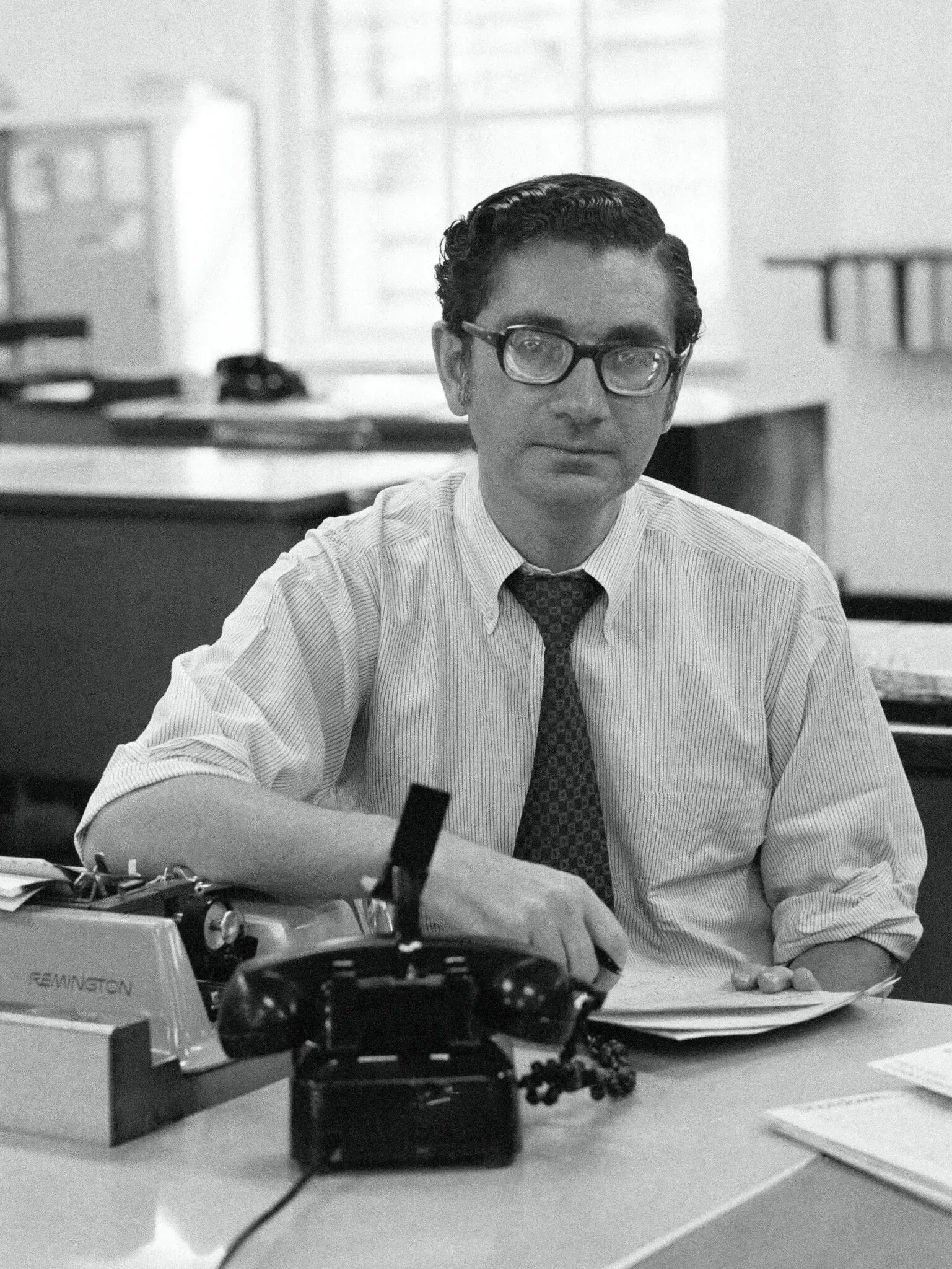
A man in a striped shirt and tie is sitting at a desk with a telephone on it.
March 7, 2025
The Don of Mafia Reporters
By Clyde Haberman September 6, 2024
Author, Actor, Politician, All with Irish Flair, 92
By Howard Blum September 6, 2024
Village Voice Co-Founder, Publisher, Soldier, Psychologist, 100
July 30, 2024
Stephen M. Silverman, age 71, reporter and historian of popular culture, died on July 6, 2023. The New York Post’s chief entertainment correspondent for years and a founding editor of people.com, he has contributed to publications across the United States and abroad, and taught journalism at Columbia University. Among his more than a dozen books are “David Lean,” “The Catskills: Its History and How It Changed America” and “The Amusement Park: 900 Years of Thrills and Spills, and the Dreamers and Schemers Who Built Them.” There will be a celebration of his life this fall after the publication of his last work, “Sondheim: His Life, His Shows, His Legacy.” He is survived by a niece, Sarah Silverman, and many devoted friends. Memorial gifts in Stephen’s name can be sent to PEN America (pen.org). Published by New York Times on Jul. 9, 2023.
June 15, 2024
Restaurant Critic Extraordinaire
June 10, 2024
Grace O’Connor, a Silurian since 1997, an award-winning reporter and editor for the Albany Times Union for 22 years, and one of the first women installed in the Hall of Honor of the Women’s Press Club of New York State, died October 29, 2022 at Branford Hills Health Care Center in Connecticut. Paul Grondahl, a former colleague at the Albany Times Union, was moved to write an appreciation, excerpted here in part: “She was old enough to be my mother and she kept a Holy Bible atop her beige metal desk, next to an IBM Selectric typewriter and rotary telephone. Grace O’Connor did not drink or curse, which, along with the Bible, made her an outlier in the rough-and-tumble bygone era of newspapering. She was on a first-name basis with half of Albany. There was only one Grace. “She was beloved by her readers and coworkers alike,” said Barb Zanella, who began as an editorial clerk at the Times Union in 1973 and worked for Grace, whom she considered a mentor and later a dear friend. A former Baptist Sunday schoolteacher, Grace brought out the better angels of the hard-drinking, cynical 20-something reporters who worked alongside her…. “There was nothing phony about Grace. She was aptly named,” said Fred LeBrun, who arrived at the Knickerbocker News in 1967, moved to the Times Union in 1970 and worked as reporter, editor, restaurant critic and columnist and who still contributes a monthly column. Grace became a kind of den mother to an unruly crew of scribes who helped pound out the first draft of history. She regularly quoted Scripture in her feature stories, which graced the Times Union from 1969 to 1991. She got her start writing for the paper’s five weekly neighborhood supplements, known as the Suns, and later served as the Suns’ editor before becoming a general assignment reporter for the main broadsheet….” For more: https://www.timesunion.com/news/article/Grondahl-Remembering-a-newsroom-full-of-Grace-17567547.php Born in Long Branch, NJ on September 13, 1927, O’Connor graduated from Manasquan High School in 1945, and attended Monmouth Junior College in Long Branch and Rutgers South Jersey in Camden, NJ. While a teacher and director of Bethesda Lutheran Nursery School in New Haven, she was published regularly in magazines, including “Ingenue,” “Teen,” and religious publications. As a community leader, she was President of the East Camden (NJ) Junior Women’s Club and a member of the state board of the New Jersey Federation of Jr. Women’s Clubs in the 1950’s, a member of the Branford, Connecticut Women’s Club in the 1960’s, and served on the board of the Community Dining Room in Branford. O’Connor is survived by her daughter Patricia and her son-in-law Carmen Cavallaro, grandsons and beloved great grandchildren who called her “Grandma Grace.” A celebration of her life and memorial service will be held at the First Baptist Church, 975 Main Street, Branford Connecticut on November 12 at 11:00.
May 23, 2024
A swell fellow, a proud Silurian, that all-round nice guy, Jim Lynn , left us on Aug. 10 due to complications from Covid. He was 88 and a retired editorial page writer at Newsday, where he had worked for 30 years. Jim, a Princeton University graduate, went to Newsday in 1972 after stints at The Long Island Star-Journal, Newsweek, New York Herald Tribune, WABC-TV and WMCA radio. He was the Trib’s Albany bureau chief in 1966, on vacation in Europe when he got word that the paper had shut down. His former colleagues at Newsday had nothing but awed references to Jim’s intelligence and wit. James Klurfeld, editorial page editor for Newsday from 1987 to 2007, remembered his friend and colleague as someone who represented old-fashioned virtues. “He was a terrific editor, a very careful fine, fine editor who always improved your writing,” Klurfeld said. “He improved my writing. I won an award for best editorials one year and I owe it all to Jim who I often showed my material to before I published it.” Carol Richards, editorial page deputy editor from 1987 to 2006, said that during those years the editorial board was strong with smart, passionate people whose political leanings covered a wide range of beliefs. Lynn was the person to count on to be informed on liberal politics. “When we were having a debate about some issue, almost always political or governmental, Jim had opinions that people would listen to,” she said. “He wasn’t a knee jerk liberal; he was a well-informed liberal.” “He always said he felt so lucky to have had the opportunities that he had,” his daughter, Nina Lynn said. “He also felt a great responsibility to use what he had been given, well and honorably.” James Dougal Lynn was born in Houlton, Maine, and graduated from high school in Mount Lebanon, Pa., where a teacher recommended that he apply to Princeton. His experience there set him on a life-changing course, his daughter Nora Curry said, which included his first introduction to bagels. “His world opened up in so many ways. He made lifelong friends, he got to be with other people who loved reading and writing and thinking the way that he did, he’d not had that before.” Dora Potter, Newsday alum, fellow Silurian and his devoted partner of 30 years, said Jim was “thoughtful of everyone.” Besides obvious acts of community service such as after he retired volunteering as a dispatcher for the local fire department, he would do unexpected, ordinary things that would never occur to others. He packed up his extensive collection of Playbills and took the train in from Long Island to give them to an Aids center for actors. He lugged interesting beer cans he’d picked up all over Europe to the delight of a friend back home who had a collection. “He never stopped thinking of others,” Potter said. “He was a steward for us all, he took care of us.” His daughters agreed, saying their father gave them a set of values to live a life with empathy and public service. He made one final act of public service: he donated his body to science. “To my dad it was sensible,” Nora Curry said. “It’s like ‘someone can use this and learn from it.’” A memorial was scheduled for Nov. 6 at the Nassau County Museum of Arts in Roslyn, where Jim was a docent. Potter said it would be both in person and on Zoom. She said she particularly wanted that option so people can choose to be safe, since both she and Jim had suffered from Covid.—By Theasa Tuohy
May 21, 2024
Frank Leonardo’s gifts of gab and camaraderie were on full display about once a month when a group of us pre-Murdoch New York Postniks congregated for breakfast at an Upper West Side diner to schmooze and reminisce. It was like Old Jews Telling Jokes except two of us were Italian. We told newspaper war stories. We vied for equal time, like GOP wannabe presidential candidates at a Fox News debate. Frank was often a step ahead. He was the only shutterbug among a bunch of scribes but that didn’t matter. He was well-read, a polymath and just as attuned to the literal side of a news story as any writer. He sometimes pissed off his reporting partner at interviews when he would lay down his camera and pose his own questions for the subject. Most of us, however, tolerated the habit. “They were good questions,” said Clyde Haberman, a charter member of the breakfast club. While Frank may at times have thought a word was worth a thousand pictures, that didn’t mean he wasn’t a crack photographer: He won two awards from the New York Press Photographers Assn., first prize in breaking news for a photo of a fireman carrying a rescued child down a ladder; and second prize for the photo of a diving polar bear, which is still a source of mirth for the Leonardo family. “I know that category was called ‘animal,’” said Frank’s wife Barbara Garson, “because I remember laughing at the plaque, which read ‘Frank Leonardo Second Class Animal.’” He did not seek plaudits. “He never entered photos into any contest including the Press Photographers,” Garson said. “In that case, I believe a former girlfriend did it for him.” Frank was born in Brooklyn in 1937. His father Thomas, also a photographer, was killed in action in World War II when Frank was eight years old. He and his mother Helen then moved to the Parkchester section of the Bronx. This early history of loss and upheaval became the blueprint for a bumpy road. Garson said young Frank dropped out, or was kicked out, of five New York City high schools before receiving a diploma from Theodore Roosevelt Night School in the Bronx. He then somehow won a scholarship to NYU, where he earned a degree in geology. Along the way, Frank met and married his first wife, Dorothea Snyder, mother of his two children, Cecilia and Thomas, who survive him. His early interest in geology waned and — Voila! — he landed a job as a news photographer for the French news service Agence France-Presse. His 40-year career was launched by catching the magic in a moment of history: Frank was the pool photographer on the roof of Montreal City Hall on July 24, 1967 when General Charles de Gaulle electrified thousands of wildly cheering Quebecois — and stirred an international uproar — by declaring, “Vive le Québec libre” (“Long Live Free Quebec”). Though Frank, says his wife, was not dazzled by celebrity, he was deeply impressed by de Gaulle’s magnetism and stature. No record exists of whether he felt the same way about The Fab Four when, on February 7, 1964, when their Pan Am Boeing 707 landed in New York. A photo of their raucous arrival at JFK records his presence among the scrum of photographers gathered behind a metal barrier. Frank also appeared in the famous documentary movie “Harlan County, USA” where he is seen filming a picket line of striking coal miners in rural Kentucky. He also witnessed the real-life event that inspired the 1975 Sidney Lumet movie “Dog Day Afternoon” when three shotgun-toting men besieged a Chase Manhattan bank in Brooklyn in an abortive attempt to trade hostages for money. Frank had little interest in the glamorous or thrilling sides of his profession. In his leisure time he enjoyed puttering with his 20-foot-long Cadillac Fleetwood Brougham (“He could fix anything,” said a family member) and he was an avid kite flyer. He owned dozens of kites that he liked to fly in the Sheep Meadow using a deep sea fishing rig to “have his own set of wings to become a bird in flight,” to paraphrase Mary Poppins. Frank Leonardo’s final job before retirement was as photo editor at CMP, a computer trade magazine. In this position he once asked a major photo agency to send him photos of subway turnstiles. One of the photos bore his own byline. ‘He called them wondering where they got it and they volunteered some pay,” said Barbara Garson. “That was the only time he ever followed up any newspaper photo of his.” That was Frank. He died of cancer on July 26 at age 86. The shutter fell and the light is extinguished. —Anthony Mancini
More Recent Obituaries