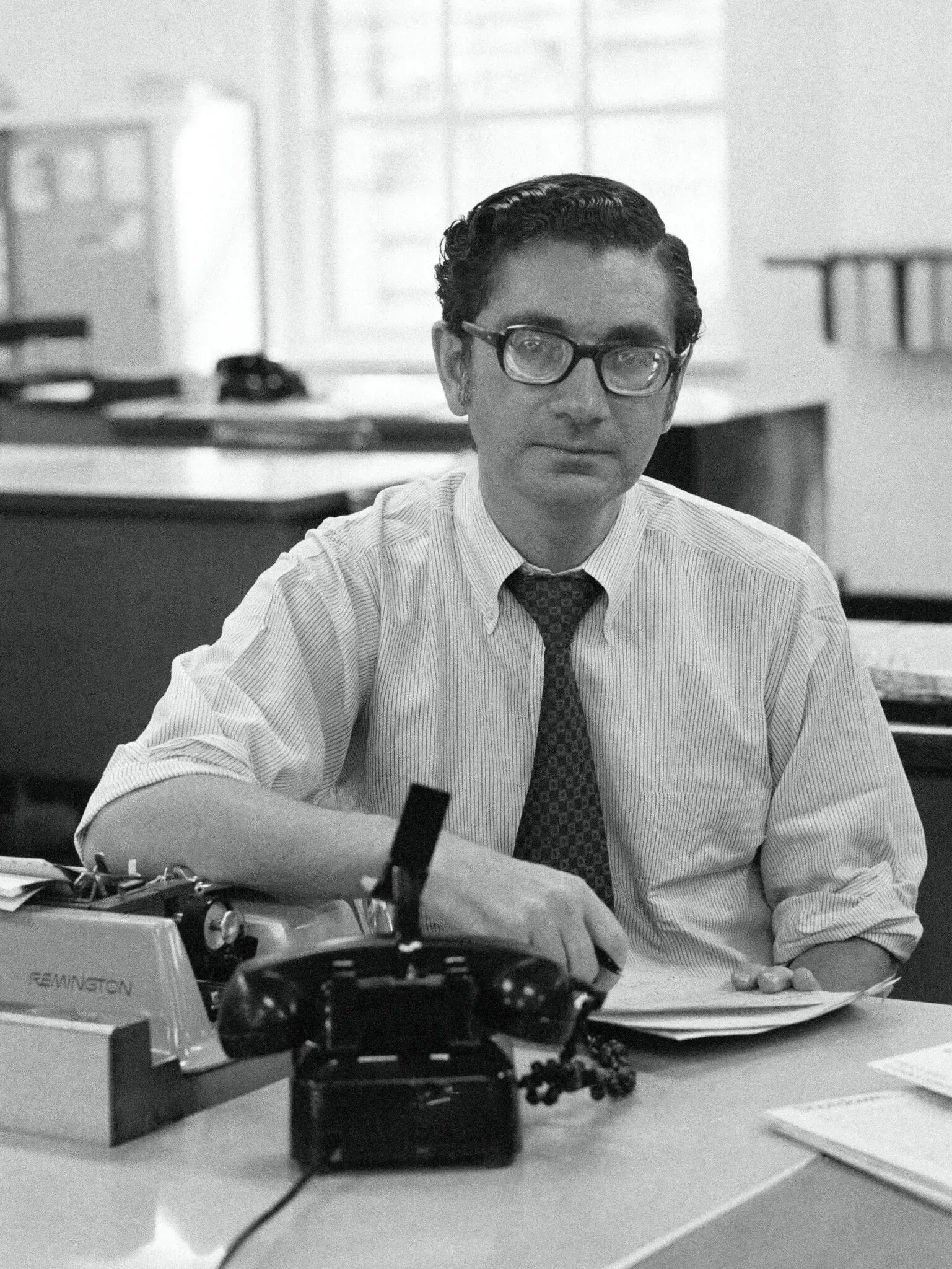
Milton Esterow
Milton Esterow, Who Brought an Investigative Edge to Stories About Nazi-Looted Art, Dies at 97
Editor’s note: On October 9, one week after Milton Esterow’s passing, his daughter Judith Esterow informed The Silurians of his death. She wrote, “Milton was a long-time member of the Silurians as well as a multiple recipient of the Silurians award. His first was in 1967 for his Page 1 New York Times story on a fake Greek horse at the Metropolitan Museum of Art. Other awards followed during his tenure at ARTnews. He died peacefully at home at age 97, and had been working on a freelance piece for the Times until three weeks before. He loved attending the monthly Silurians lunches and much enjoyed chatting with old colleagues and meeting new fellow journalists.” Here are excerpts from the obituary that appeared in the New York Times by staff reporter Jeré Longman.
--
Milton Esterow, a New York Times arts journalist who, in 1972, bought and reinvigorated ARTnews magazine and, at both media outlets, helped bring an investigative edge to culture reporting, especially regarding artwork looted by the Nazis, died on Oct. 3 at his home in Manhattan. He was 97.
Mr. Esterow joined The New York Times as a 17-year-old copy boy in 1945, became assistant to the director of cultural news before he left the paper in 1968, and returned nearly a half-century later as a freelancer.
A draft of his final article, about the restitution of art stolen during the Holocaust was submitted before he died and remains scheduled for publication in the near future.
Mr. Esterow found his niche at The Times by bringing the toughness of his early coverage on the crime beat to culture reporting. On Nov. 16, 1964, his article about treasures stolen by the Nazis appeared on the front page of The Times under the headline “Europe is Still Hunting Its Plundered Art.” It inspired him to dig further into the topic, leading to his book “The Art Stealers” (1966).
“This had never been done at the paper before, doing investigative journalism, getting behind the scenes and interviewing the key players, the artists, the collectors, the dealers, the scholars,” Mr. Esterow said in a 2009 lecture at the University of Southern California.
Itching for a bigger role, he left The Times to run the publishing division of Kennedy art galleries in New York and, in 1972, to lead an eight-person investor group in purchasing ARTnews from Newsweek, then a division of The Washington Post Company.
ARTnews, a monthly founded in 1902, was the nation’s oldest arts magazine, but it was adrift financially, with a circulation of only about 30,000. Mr. Esterow instituted a makeover, moving beyond the publication’s traditional focus on reviews to broaden and sharpen its coverage of what he called the “fascinating and mysterious” happenings of the art world.
Under his stewardship as publisher and editor, ARTnews became one of the most widely circulated art magazines. It won a National Magazine Award for general excellence in 1981 and George Polk Awards for cultural reporting in 1980 and 1991, the latter for investigating art stolen by the Soviets during its occupation of Germany after World War II.
In 1984, Mr. Esterow received a tip that a monastery in Mauerbach, Austria, was rumored to house thousands of artworks confiscated by the Nazis. (An estimated 25,000 Jewish homes were sacked in Austria.) He and his wife flew to Vienna, where the minister of the Federal Monuments Office of Austria, pounding on his desk, declined to let him visit the monastery, as Mr. Esterow recounted in his 2009 lecture.
He told the minister that such a defensive posture made him suspicious and “that maybe you’re hiding something.” The interview quickly ended.
Back home, Mr. Esterow assigned a contributing editor, Andrew Decker, to the story. It was published in December 1984 under the headline “A Legacy of Shame.” Almost every year for a decade, ARTnews continued to report on what the Austrian government acknowledged was its deficient handling of the return of the monastery art objects to their rightful owners and heirs.
In 1985, Austria announced a plan to return 8,000 works of art and other objects taken from Jews by the Nazis. According to ARTnews, 77 paintings and 236 other objects were returned. In 1995, the remaining objects were transferred to the Federation of Jewish Communities of Austria. They were auctioned in 1996 by Christie’s, raising more than $14 million to help needy Holocaust victims and their heirs.
Mr. Esterow sold ARTnews in 2014, after its circulation had risen to 80,000, for an undisclosed amount. Afterward, Mr. Esterow contributed freelance articles to The Times and continued to report on the Nazi looting.
In 2016, Austria’s consul general, Georg Heindl, honored Mr. Esterow and Mr. Decker on behalf of the country, saying they had “contributed to Austria facing its past honestly and thereby becoming, in a way, a better country.”
Milton Esterow was born on July 28, 1928, in Brooklyn. His father, Bernard Esterow, owned a small grocery. His mother, Yetta (Barash) Esterow, managed the home. At 10, Milton published a neighborhood newspaper that he sold for two cents a copy. On joining The Times, his first assignment as a copy boy was to buy the latest edition of The Daily Racing Form for the managing editor, who placed his horseracing bets with Mr. Esterow’s boss, the chief copy boy.
After being promoted to reporter in 1948, Mr. Esterow dropped out of Brooklyn College, figuring he would learn journalism by practicing it over studying it.
In addition to his daughter Judith—a former associate publisher of ARTnews—he is survived by another daughter, Deborah Rothstein; three grandchildren; two step-grandchildren; two great-grandchildren; and four step great-grandchildren. His wife of 74 years, Jacqueline (Levine) Esterow, died in May.
Obituaries