Lou Sepersky

You couldn’t miss Lou Sepersky at a Silurians luncheon.


Tall and lanky at 6’4, with a rakish head of salt-and-pepper hair, he would tower over the table with his unassuming personality and ever-ready smile. Lou, a journalist who found his true calling in community leadership, advocating for issues ranging from transportation to women’s rights and civil rights, died of cancer on Sept. 18 at his home in Manhattan. He was 87. 


“He had a progressive mind and understood that civil and women’s rights were everyone’s concern,” said Leida Snow, his wife of more than 41 years and a fellow Silurian. Lou went south during Freedom Summer in 1964. 


From 1962 through 1975, Lou reported for the Staten Island Advance, The New York Post under Dolly Schiff, UPI, and McGraw Hill, as well as two New Jersey newspapers: the Herald News in Passaic and the Hudson Dispatch in Union City. But as a lifelong Democrat and New Yorker, with a Bachelor’s degree in political science from Drake University and a Master’s in history from the University of Michigan, Lou decided “to get his PhD in New York politics,” Leida said. 

From journalism he segued to community activism, serving for more than 50 years on Community Board 6, which encompassed his home district of Manhattan’s East Side. First appointed to the board by Manhattan Borough President C. Virginia Fields, he was subsequently reappointed by every succeeding borough president. 


 He served as Board Chair for two years but was happiest working behind the scenes. A list of his leadership positions reads like a paean to grass-roots activism. He was chair of the Transportation Committee, a longtime member of the Land Use and Waterfront Committee, and also served on the Parks, Landmarks and Cultural Affairs Committee, the Public Safety Committee, and other committees. 


As a transportation advocate, one of Lou’s most passionate causes was the Second Avenue Subway, which he championed tirelessly as early as 1998. Books, newspaper articles, and reports identify him as a “concerned citizen” who pressed for a “fully built” Second Avenue subway at hearings and meetings and worked with elected officials to assure funding for the project. He also pushed unsuccessfully for the JFK AirTrain to continue through to Manhattan, telling the New York Post in 2001 that the $64 million spent on the train was a “colossal waste of money” since it ends in Jamaica.


When a plan arose for the East 34th Street Heliport to hold events like tai chi, farmers’ markets, and a beer garden, Lou was there to talk sense. The now-defunct New York and Chicago website DNAinfo.com quoted him in 2017: “A pilot traveling in an emergency situation does not have the option of looking out and saying, ‘I can’t land there because there’s a rock concert going on,’” he said.


Lou advocated for affordable housing in the plan to redevelop two Con Edison parcels along First Avenue south of the U.N. Among the ways he showed support for women was by donating to a group now called Women Creating Change, among only a handful of men to do so in 2019. His Letter to the Editor advocating a woman’s right to choose appeared in the New York Times in 1982. His letter on congestion pricing, published in the Times in 2007, still is relevant. 

Lou’s other roles included serving as the Community District 6 historian and working as a photographer who gravitated to politicians as his subjects. His photo of the late Democratic Congressman Ted Weiss, who served in the House of Representatives for New York from 1977 until his death in 1992, hangs in the Ted Weiss Federal Building in Lower Manhattan. Other examples of Lou’s excellently composed photos can be found in various local publications, often accompanying an article by Leida Snow.


Born in Brooklyn in 1935, Lou spent his adult life living on Manhattan’s East Side—for decades in the East Fifties with Leida. She described him as a passionate New Yorker who was on “the right side” of every important issue. The couple chose to remain in New York during the Covid pandemic while many others left, just one of the many issues they agreed on. 


 “Lou loved to walk around the city—everything was a show,” Leida said. “The thing that hurt was he couldn’t do it at the end.”

Upon learning of Lou’s passing, several prominent Democratic leaders contacted Leida, identifying Lou as someone who made a difference. Among those were Congressman Jerry Nadler, former Congresswoman Carolyn Maloney, and State Senator Liz Krueger. — Roberta Hershenson     

Obituaries
December 22, 2025
Milton Esterow, Who Brought an Investigative Edge to Stories About Nazi-Looted Art, Dies at 97
By Jack Deacy December 22, 2025
The ‘Heart and Soul of the New York Post,’ Myron Rushetzky, 73, Loses Battle with Cancer
By Mort Sheinman June 5, 2025
Top Editor, True-Blue Silurian, July 5, 1933-June 1, 2025
By Joseph Berger April 30, 2025
The Pulitzer Prize-winning correspondent and former Executive Editor was the public ideal of a New York Times man: polished, erudite and well spoken.
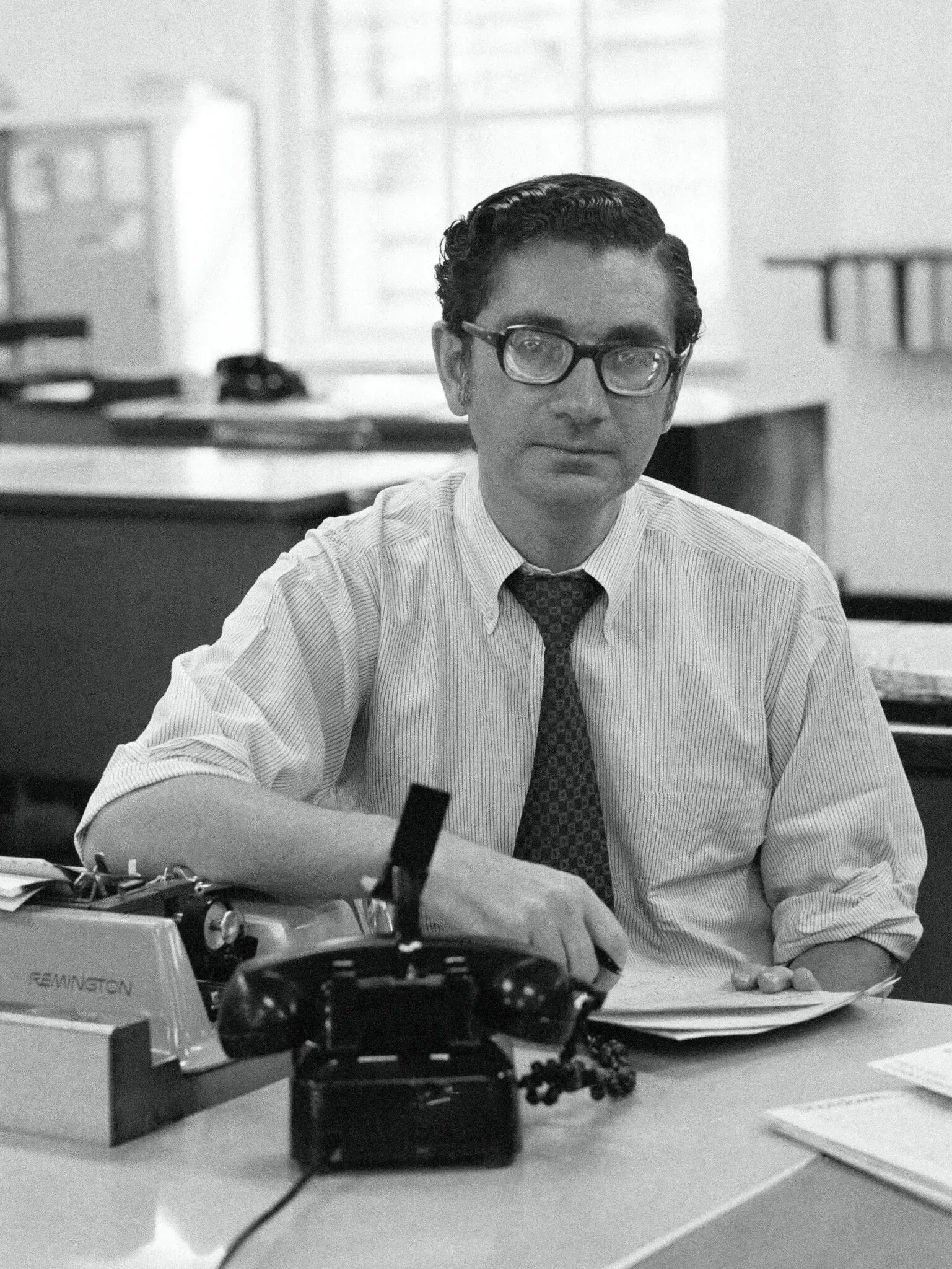
A man in a striped shirt and tie is sitting at a desk with a telephone on it.
March 7, 2025
The Don of Mafia Reporters
By Clyde Haberman September 6, 2024
Author, Actor, Politician, All with Irish Flair, 92
By Howard Blum September 6, 2024
Village Voice Co-Founder, Publisher, Soldier, Psychologist, 100
By By Mort Sheinman August 1, 2024
Iconoclastic Reviewer of Our Most Popular Medium
July 30, 2024
Stephen M. Silverman, age 71, reporter and historian of popular culture, died on July 6, 2023. The New York Post’s chief entertainment correspondent for years and a founding editor of people.com, he has contributed to publications across the United States and abroad, and taught journalism at Columbia University. Among his more than a dozen books are “David Lean,” “The Catskills: Its History and How It Changed America” and “The Amusement Park: 900 Years of Thrills and Spills, and the Dreamers and Schemers Who Built Them.” There will be a celebration of his life this fall after the publication of his last work, “Sondheim: His Life, His Shows, His Legacy.” He is survived by a niece, Sarah Silverman, and many devoted friends. Memorial gifts in Stephen’s name can be sent to PEN America (pen.org). Published by New York Times on Jul. 9, 2023.
June 15, 2024
Restaurant Critic Extraordinaire
June 10, 2024
Grace O’Connor, a Silurian since 1997, an award-winning reporter and editor for the Albany Times Union for 22 years, and one of the first women installed in the Hall of Honor of the Women’s Press Club of New York State, died October 29, 2022 at Branford Hills Health Care Center in Connecticut. Paul Grondahl, a former colleague at the Albany Times Union, was moved to write an appreciation, excerpted here in part: “She was old enough to be my mother and she kept a Holy Bible atop her beige metal desk, next to an IBM Selectric typewriter and rotary telephone. Grace O’Connor did not drink or curse, which, along with the Bible, made her an outlier in the rough-and-tumble bygone era of newspapering. She was on a first-name basis with half of Albany. There was only one Grace. “She was beloved by her readers and coworkers alike,” said Barb Zanella, who began as an editorial clerk at the Times Union in 1973 and worked for Grace, whom she considered a mentor and later a dear friend. A former Baptist Sunday schoolteacher, Grace brought out the better angels of the hard-drinking, cynical 20-something reporters who worked alongside her…. “There was nothing phony about Grace. She was aptly named,” said Fred LeBrun, who arrived at the Knickerbocker News in 1967, moved to the Times Union in 1970 and worked as reporter, editor, restaurant critic and columnist and who still contributes a monthly column. Grace became a kind of den mother to an unruly crew of scribes who helped pound out the first draft of history. She regularly quoted Scripture in her feature stories, which graced the Times Union from 1969 to 1991. She got her start writing for the paper’s five weekly neighborhood supplements, known as the Suns, and later served as the Suns’ editor before becoming a general assignment reporter for the main broadsheet….” For more: https://www.timesunion.com/news/article/Grondahl-Remembering-a-newsroom-full-of-Grace-17567547.php Born in Long Branch, NJ on September 13, 1927, O’Connor graduated from Manasquan High School in 1945, and attended Monmouth Junior College in Long Branch and Rutgers South Jersey in Camden, NJ. While a teacher and director of Bethesda Lutheran Nursery School in New Haven, she was published regularly in magazines, including “Ingenue,” “Teen,” and religious publications. As a community leader, she was President of the East Camden (NJ) Junior Women’s Club and a member of the state board of the New Jersey Federation of Jr. Women’s Clubs in the 1950’s, a member of the Branford, Connecticut Women’s Club in the 1960’s, and served on the board of the Community Dining Room in Branford. O’Connor is survived by her daughter Patricia and her son-in-law Carmen Cavallaro, grandsons and beloved great grandchildren who called her “Grandma Grace.” A celebration of her life and memorial service will be held at the First Baptist Church, 975 Main Street, Branford Connecticut on November 12 at 11:00.
May 23, 2024
A swell fellow, a proud Silurian, that all-round nice guy, Jim Lynn , left us on Aug. 10 due to complications from Covid. He was 88 and a retired editorial page writer at Newsday, where he had worked for 30 years. Jim, a Princeton University graduate, went to Newsday in 1972 after stints at The Long Island Star-Journal, Newsweek, New York Herald Tribune, WABC-TV and WMCA radio. He was the Trib’s Albany bureau chief in 1966, on vacation in Europe when he got word that the paper had shut down. His former colleagues at Newsday had nothing but awed references to Jim’s intelligence and wit. James Klurfeld, editorial page editor for Newsday from 1987 to 2007, remembered his friend and colleague as someone who represented old-fashioned virtues. “He was a terrific editor, a very careful fine, fine editor who always improved your writing,” Klurfeld said. “He improved my writing. I won an award for best editorials one year and I owe it all to Jim who I often showed my material to before I published it.” Carol Richards, editorial page deputy editor from 1987 to 2006, said that during those years the editorial board was strong with smart, passionate people whose political leanings covered a wide range of beliefs. Lynn was the person to count on to be informed on liberal politics. “When we were having a debate about some issue, almost always political or governmental, Jim had opinions that people would listen to,” she said. “He wasn’t a knee jerk liberal; he was a well-informed liberal.” “He always said he felt so lucky to have had the opportunities that he had,” his daughter, Nina Lynn said. “He also felt a great responsibility to use what he had been given, well and honorably.” James Dougal Lynn was born in Houlton, Maine, and graduated from high school in Mount Lebanon, Pa., where a teacher recommended that he apply to Princeton. His experience there set him on a life-changing course, his daughter Nora Curry said, which included his first introduction to bagels. “His world opened up in so many ways. He made lifelong friends, he got to be with other people who loved reading and writing and thinking the way that he did, he’d not had that before.” Dora Potter, Newsday alum, fellow Silurian and his devoted partner of 30 years, said Jim was “thoughtful of everyone.” Besides obvious acts of community service such as after he retired volunteering as a dispatcher for the local fire department, he would do unexpected, ordinary things that would never occur to others. He packed up his extensive collection of Playbills and took the train in from Long Island to give them to an Aids center for actors. He lugged interesting beer cans he’d picked up all over Europe to the delight of a friend back home who had a collection. “He never stopped thinking of others,” Potter said. “He was a steward for us all, he took care of us.” His daughters agreed, saying their father gave them a set of values to live a life with empathy and public service. He made one final act of public service: he donated his body to science. “To my dad it was sensible,” Nora Curry said. “It’s like ‘someone can use this and learn from it.’” A memorial was scheduled for Nov. 6 at the Nassau County Museum of Arts in Roslyn, where Jim was a docent. Potter said it would be both in person and on Zoom. She said she particularly wanted that option so people can choose to be safe, since both she and Jim had suffered from Covid.—By Theasa Tuohy
More Recent Obituaries